Space Logos: Design Lessons from 80 Years of Mission Insignia
What can rocket science teach you about logo design? More than you'd expect.
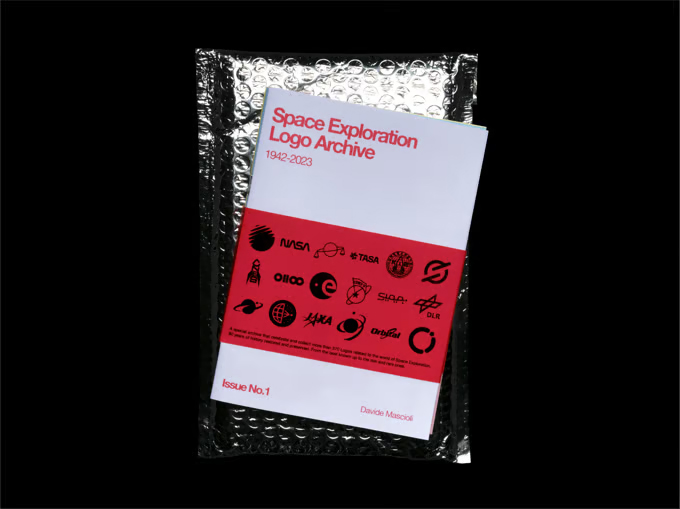
The SELA (Space Exploration Logo Archive) project — assembled by Rome-based designer Davide Mascioli — catalogs over 370 space logos spanning 1942 to 2023. Eight decades of mission patches, agency emblems, and spacecraft insignia represent one of the richest unexamined logo design archives on the planet.
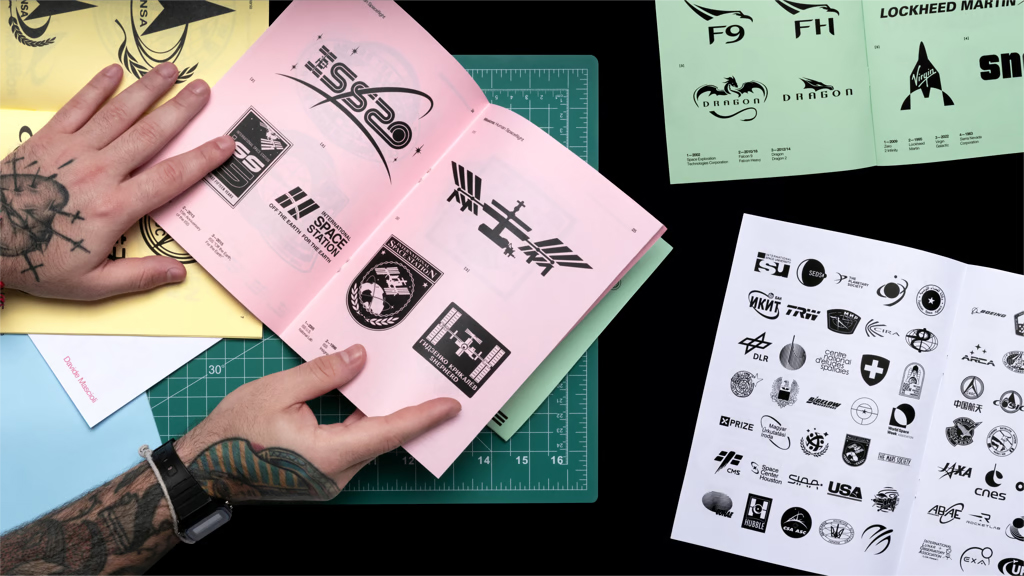
This isn't just a history lesson. Space logos operate under extreme constraints: they must read clearly at thumbnail size on a spacesuit patch, reproduce in a single color on technical documents, and communicate mission identity instantly to both specialists and the public. Those constraints are exactly the same pressures your SMB logo faces.
Here's what 80 years of space mission design teaches us about building logos that actually work.
Geometric Construction Is the Foundation of Durable Logos
Flip through the SELA archive and one pattern immediately stands out: virtually every long-lasting space logo is built on a geometric skeleton. Circles, triangles, chevrons, and orbital ellipses dominate — not because designers lacked imagination, but because pure geometry is the most scalable visual language available.
Why does this matter for your logo?
Geometric forms carry universal associations. A circle implies completeness, unity, global reach. A triangle points upward — ambition, stability, direction. An arrow or chevron communicates forward momentum. Space agencies understood this intuitively: NASA's "meatball" logo layers a circular orbit, a red chevron, and a star field — each element independently readable, collectively unmistakable.
The practical technique: Before sketching any concept, define the primary geometric container for your mark. Is it circle-based (approachable, unified), triangle-based (dynamic, aspirational), or grid-based (structured, technical)? That skeleton should survive even if every decorative detail is stripped away.
One critical test: reduce your logo to a 16×16 pixel favicon. If the geometric core still reads — if the shape is still identifiable — you have a structurally sound logo. If it dissolves into noise, the geometry isn't strong enough.
Color Palettes That Communicate Mission Before You Read a Word
Space logos use color with unusual discipline. Browse the SELA archive and you'll notice most mission logos use three colors or fewer — and those colors are almost never arbitrary.
Deep blue dominates because it carries specific meanings in aerospace contexts: authority, precision, the infinite void of space itself. Gold and yellow signal achievement and technical excellence. Red creates urgency and draws the eye. White provides contrast and communicates clarity.
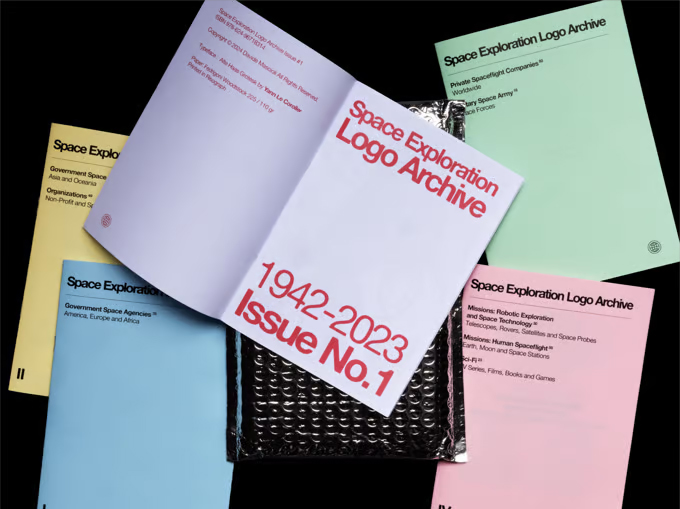
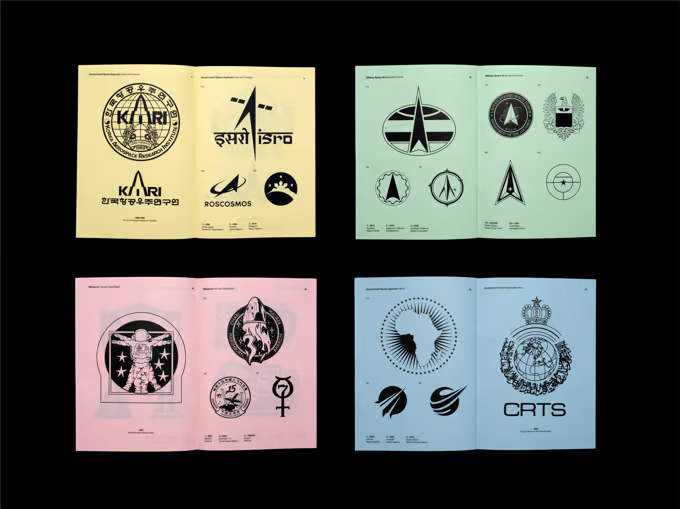
The SELA project itself is organized by color palette — each of the five mini-books uses a distinct color system to distinguish thematic chapters. This is sophisticated information architecture: color becomes a navigational tool, not just decoration.
For SMB logos, the color lesson is this: choose colors that do conceptual work, not just aesthetic work. Ask what each color communicates before asking whether it looks nice. A restaurant logo that uses deep navy isn't wrong — but navy communicates authority and precision, not warmth and appetite. The color is fighting the brand message.
A practical framework for color selection:
- Identify your primary emotional register. Trustworthy? Energetic? Premium? Approachable?
- Find the color family that carries that register. Blues and greens for trust; oranges and reds for energy; gold and dark tones for premium; pastels and rounded forms for approachable.
- Test it at 100% black. Your logo must work in single-color reproduction. If the composition depends on color to communicate hierarchy, that's a structural problem.
Typography in Mission Logos: Why Condensed Sans-Serif Won
Look at the lettering across eight decades of space mission patches. The typography evolution tells a clear story: condensed, geometric sans-serifs gradually replaced decorative and serif treatments because readability under pressure is non-negotiable.
Early mission logos often used ornate script lettering — fine for ceremonial contexts, problematic when reproduced at small sizes on technical documentation. By the 1970s and 1980s, most major space agencies had converged on tight, geometric letterforms with high x-heights and minimal stroke variation.
This convergence wasn't aesthetic fashion. It was functional optimization. High x-height letterforms remain readable at small sizes. Minimal stroke variation survives photocopying and embroidery. Geometric construction aligns visually with the geometric marks they accompany.
For your logo typography:
- Pair a geometric mark with a geometric typeface. Organic, hand-drawn marks can pair with humanist type. Angular, precise marks need letterforms with similar construction logic.
- Avoid font weight extremes. Ultra-thin weights disappear at small sizes. Ultra-heavy weights merge at distance. A medium-to-bold weight in a condensed cut gives you the best range.
- Treat the wordmark as a shape, not just text. The negative space between letters, the visual rhythm of ascenders and descenders — these are compositional elements that affect the logo's overall geometry.
Negative Space as Active Design Territory
Some of the most memorable mission insignias in the SELA archive use negative space as a primary design element — a planet visible in the absence of surrounding stars, an orbital path defined by the gap between two shapes.
Negative space is free visual information. Every logo has it; most logos waste it.
The most durable logos treat the space inside and around the mark as deliberately designed territory. FedEx's hidden arrow is the canonical example — but the technique appears throughout space logo design, where the constraints of patch reproduction force designers to work every pixel.
The practical approach: after completing a logo draft, invert it to black on white and white on black. Then look specifically at the shapes the negative space forms. Are they accidental or intentional? Could a refinement of the positive forms create a meaningful secondary shape in the negative space?
This isn't about hiding Easter eggs. It's about using the full canvas — both the mark itself and the visual weight it creates against backgrounds.
What an 80-Year Archive Teaches About Longevity
Davide Mascioli spent months researching this archive, sourcing logos from specialist communities at spacefacts.de, collectspace.com, and spacepatches.nl. The logos that survived eight decades of reproduction — appearing in books, websites, embroidered patches, metal plaques, and digital displays — share consistent structural properties.
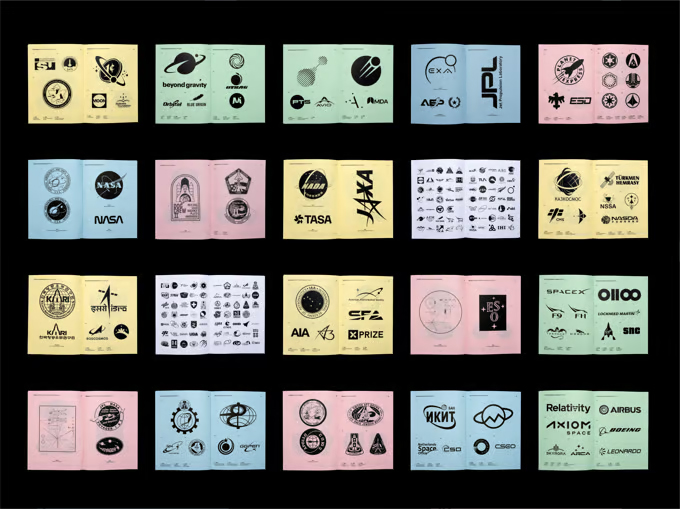
The logos that lasted:
- Built on strong geometric foundations that survived medium changes
- Used color symbolically, not decoratively
- Relied on letterforms with high x-heights and minimal stroke variation
- Treated negative space as compositional territory
- Communicated their core concept at any scale from favicon to billboard
The logos that didn't last — the ones that feel dated or barely survived reproduction — share opposite characteristics: decorative complexity that couldn't survive scaling, color relationships that only worked in full-color reproduction, typography that depended on large-scale rendering.
Apply This to Your Own Logo
You don't need to design a space mission patch. But the design pressures that shaped 80 years of space exploration logos are identical to what your business logo faces: it needs to work at every size, in every color context, across every medium, for decades.
Start with the geometry. Build your color palette around conceptual meaning. Choose typography that aligns with the construction logic of your mark. Treat negative space as design territory, not empty canvas.
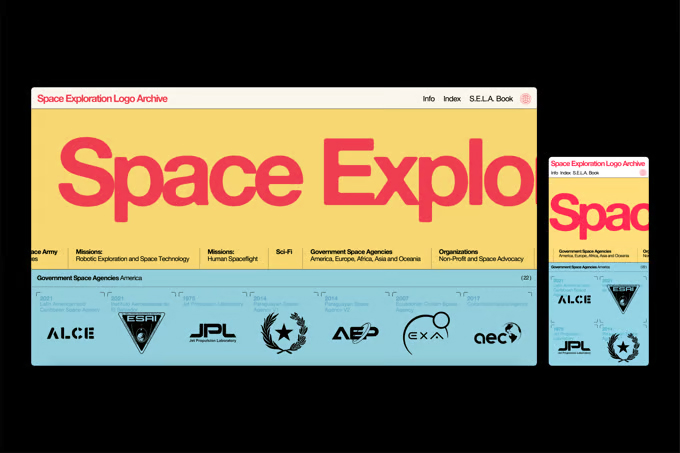
The full SELA archive — including downloadable vector files — is available at spaceexplorationlogoarchive.webflow.io. Browsing 370 logos with fresh eyes for structural patterns is one of the most useful exercises a designer or business owner can do before commissioning or creating a logo.
The best design lessons often come from contexts that seem unrelated to your own. Rocket science, it turns out, is excellent logo school.