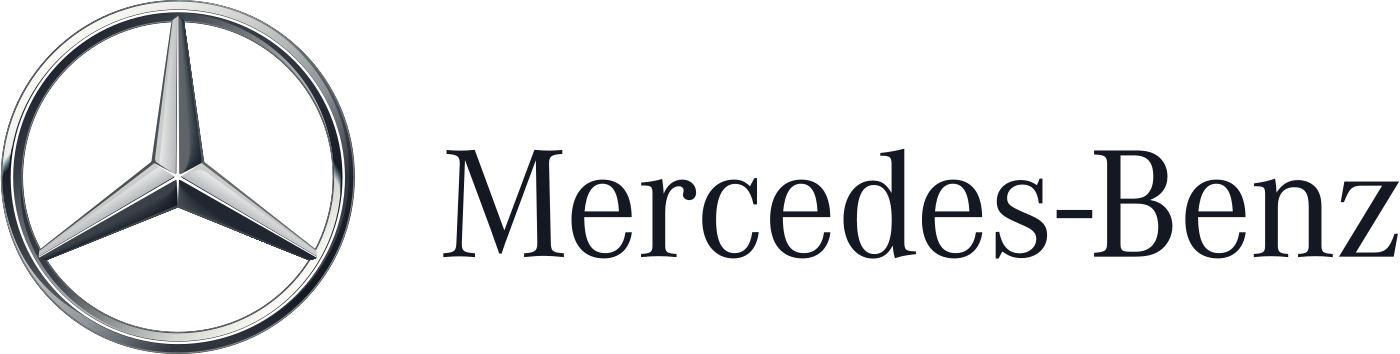
Mercedes-Benz three-pointed star logo
Mercedes-Benz
Mercedes-Benz · Stuttgart, Germany
Mercedes-Benz's iconic three-pointed star logo represents the brand's dominance over land, sea, and air transportation, symbolizing over a century of automotive luxury, engineering excellence, and timeless elegance.
DESIGN INFO
Brand Overview
Mercedes-Benz is one of the world's most prestigious automotive manufacturers, born from the 1926 merger of Karl Benz's Benz & Cie. and Gottlieb Daimler's Daimler-Motoren-Gesellschaft — two companies whose founders independently invented the gasoline-powered automobile in 1886. Headquartered in Stuttgart, Germany, the brand operates under the parent company Mercedes-Benz Group AG and produces a comprehensive range of luxury vehicles, from sedans and SUVs to high-performance AMG models and electric EQ vehicles. The brand has consistently positioned itself at the pinnacle of automotive luxury and engineering innovation. Mercedes-Benz pioneered numerous safety technologies, including the crumple zone, anti-lock braking system (ABS), and electronic stability program (ESP), earning its reputation with the motto 'The Best or Nothing' (Das Beste oder Nichts). The company sells vehicles in virtually every global market, with particularly strong presence in Europe, North America, and China. Beyond passenger cars, Mercedes-Benz has a significant presence in commercial vehicles through its Trucks and Vans divisions. The brand also maintains a rich motorsport heritage, competing in Formula One through the Mercedes-AMG Petronas team. With its commitment to electrification through the EQ sub-brand and its vision of sustainable luxury mobility, Mercedes-Benz continues to shape the future of the automotive industry while honoring its unmatched legacy as the inventor of the automobile.
Founded
1926
Headquarters
Stuttgart, Germany
Industry
Automotive
Logo History
The Mercedes-Benz three-pointed star has one of the most storied histories in corporate identity. Its origins trace back to Gottlieb Daimler, who reportedly marked a star on a postcard of Deutz, Germany, telling his wife that this star would one day shine over his factory. The three points symbolized Daimler's ambition for motorization on land, water, and in the air. Daimler-Motoren-Gesellschaft first registered the three-pointed star as a trademark in 1909, initially offering both three-pointed and four-pointed versions. The three-pointed star was selected for use and first appeared on vehicles in 1910. Meanwhile, Benz & Cie. used a laurel wreath encircling the word 'Benz' as its emblem. When the two companies merged in 1926 to form Daimler-Benz, their logos were combined: the three-pointed star was placed within a laurel wreath, with 'Mercedes-Benz' inscribed around the border. This combined emblem underwent gradual refinement over the following decades, with the design becoming progressively cleaner and more streamlined. By the 1930s, the star was enclosed in a circle, and the laurel wreath was simplified. Throughout the mid-20th century, the logo evolved toward greater minimalism. The modern iteration features a simple silver three-pointed star within a circle, stripped of all ornamental elements. In recent years, particularly with the launch of the EQ electric vehicle line, Mercedes-Benz has employed a flat, two-dimensional version of the star, reflecting contemporary design trends while preserving the instantly recognizable silhouette that has represented automotive excellence for over a century.
Design Philosophy
The Mercedes-Benz logo embodies a design philosophy rooted in simplicity, symmetry, and enduring elegance. The three-pointed star is a masterclass in geometric precision — three equidistant points radiating from a central axis, enclosed within a perfect circle. This mathematical harmony conveys stability, balance, and completeness, qualities that directly mirror the brand's engineering principles. The philosophy behind the logo reflects the concept of 'less is more.' Over more than a century, the design has been progressively distilled to its essential elements, removing decorative flourishes while strengthening its core identity. Each simplification has made the mark more versatile and more powerful, proving that reduction can amplify rather than diminish brand recognition. The enclosing circle serves multiple symbolic functions. It represents unity and wholeness, while also functioning as a protective boundary that elevates the star within it. The upward-pointing apex of the star suggests aspiration and forward movement, subtly communicating ambition and progress without resorting to aggressive or dynamic shapes. Mercedes-Benz's design approach also demonstrates remarkable restraint in dimensionality. While the brand has used chrome three-dimensional hood ornaments — perhaps the most famous physical logo application in automotive history — the underlying design works equally well as a flat graphic. This dimensional flexibility is a hallmark of truly great logo design. The logo's visual weight is carefully calibrated: substantial enough to convey authority and prestige, yet refined enough to avoid heaviness. This balance between strength and sophistication perfectly encapsulates the brand's dual promise of powerful performance and cultivated luxury.
Color Analysis
The Mercedes-Benz color palette centers on silver and black — a deliberately restrained combination that communicates luxury through understatement rather than ostentation. This chromatic restraint is itself a design statement, positioning the brand above trends and seasonal color fashions. Silver is the signature color of Mercedes-Benz, so deeply associated with the brand that 'Silver Arrows' (Silberpfeile) became the legendary nickname for the company's racing cars. The origin dates to the 1934 Eifelrennen race, where the team allegedly stripped white paint from their cars to meet weight regulations, revealing the bare silver aluminum underneath. Silver communicates technological sophistication, precision engineering, and modernity. It carries associations with precious metals, reinforcing the perception of value and quality. Black provides the essential counterpoint to silver, grounding the palette with authority, formality, and timeless elegance. In the logo application, black often serves as the background or text color, creating maximum contrast with the silver star. The combination of silver and black avoids the warmth of gold-based luxury palettes, instead projecting a cooler, more intellectual form of prestige — one rooted in engineering achievement rather than decorative excess. The near-absence of additional colors in the primary brand identity is itself significant. By refusing to introduce secondary accent colors, Mercedes-Benz maintains an exceptionally clean and unified visual presence. This monochromatic discipline ensures that the brand reads consistently across every touchpoint — from the chrome hood ornament to dealership signage to digital interfaces — reinforcing recognition through chromatic consistency rather than variety.
Silver
#C0C0C0
Black
#1A1A1A
Public Perception
Mercedes-Benz consistently ranks among the world's most recognized and respected brands. The three-pointed star is universally understood as a symbol of luxury, quality, and engineering prowess. Consumer perception studies regularly place Mercedes-Benz at the top of automotive brand prestige rankings, with the logo itself serving as a powerful status signifier across cultures and demographics. The brand carries particularly strong associations with safety, reliability, and technological innovation — perceptions built over decades of genuine engineering leadership. The famous hood-mounted star ornament has become a cultural icon beyond the automotive world, appearing in film, music, and fashion as shorthand for success and sophistication. In recent years, Mercedes-Benz has successfully modernized its image without alienating its traditional customer base. The introduction of the EQ electric vehicle line and updated visual identity has attracted younger consumers while maintaining loyalty among established buyers. The flat logo treatment signals that the brand is forward-looking while the fundamental star design ensures continuity with its heritage. Market research indicates that the Mercedes-Benz logo generates immediate trust and premium expectations, making it one of the most commercially valuable brand marks in existence.
Design Insights for Small Business
The Mercedes-Benz logo offers several powerful lessons for businesses of any size seeking to build a lasting visual identity. First, invest in geometric simplicity. The three-pointed star is built from basic geometric forms — a triangle inscribed in a circle — yet it is instantly recognizable worldwide. Small businesses should resist the temptation to create complex logos with multiple elements. A simple, well-proportioned mark will be more memorable, more versatile, and more durable than an elaborate design. Second, let your logo carry genuine meaning. The three points of the Mercedes star represent a real aspiration — dominance across land, sea, and air transportation. When your logo connects to an authentic story or mission, it becomes more than decoration; it becomes a vehicle for your brand narrative. Identify the core purpose of your business and explore how simple visual metaphors might express it. Third, practice the discipline of subtraction. The Mercedes-Benz logo has become more powerful as it has become simpler over the decades. Review your current branding and ask what can be removed without losing meaning. Elimination of unnecessary elements almost always strengthens a design. Fourth, commit to chromatic restraint. Mercedes-Benz built one of the world's most prestigious brand identities with essentially two colors. A limited palette is easier to apply consistently, less expensive to reproduce, and typically more sophisticated than a multi-color approach. Finally, design for dimensional flexibility. Ensure your logo works as a flat graphic, a three-dimensional object, a tiny favicon, and a large sign. The Mercedes star succeeds in every context because its fundamental geometry is sound at any size or treatment.
Automotive Related Cases


Your logo journey starts today.
Generate 3 logo concepts for free, then purchase the one you love. No credit card required — 7-day money-back guarantee.
Create Your Logo Free